

 Facebook
 X
X
 Pinterest
 Copy Link
Why Is My REALTOR® Asking Me to Sign a Buyer Agreement in Texas?
What Abilene homebuyers should know about the new requirements—and the choices you still have
If you’ve tried to look at a home recently, you may have encountered something that feels different.
You call a REALTOR® about a property, and before they can show it to you, they’re asking you to sign paperwork.
Yes, Texas law has changed, and some of that paperwork is now required. But required paperwork does not mean you don’t have choices about what you’re agreeing to.
There are several ways these agreements can be structured, and buyers should understand those options before signing anything.
So let’s make these forms a little less intimidating.
First: Information About Brokerage Services
One of the first forms you’re likely to receive is called Information About Brokerage Services, commonly referred to as the IABS.
The biggest thing to understand:
This is not a representation agreement.
You’re not hiring an agent simply by acknowledging receipt of this form. The IABS explains the different ways a Texas real estate license holder can work with you, including representation of a buyer or seller, intermediary relationships, and circumstances in which a property can be shown to an unrepresented buyer.
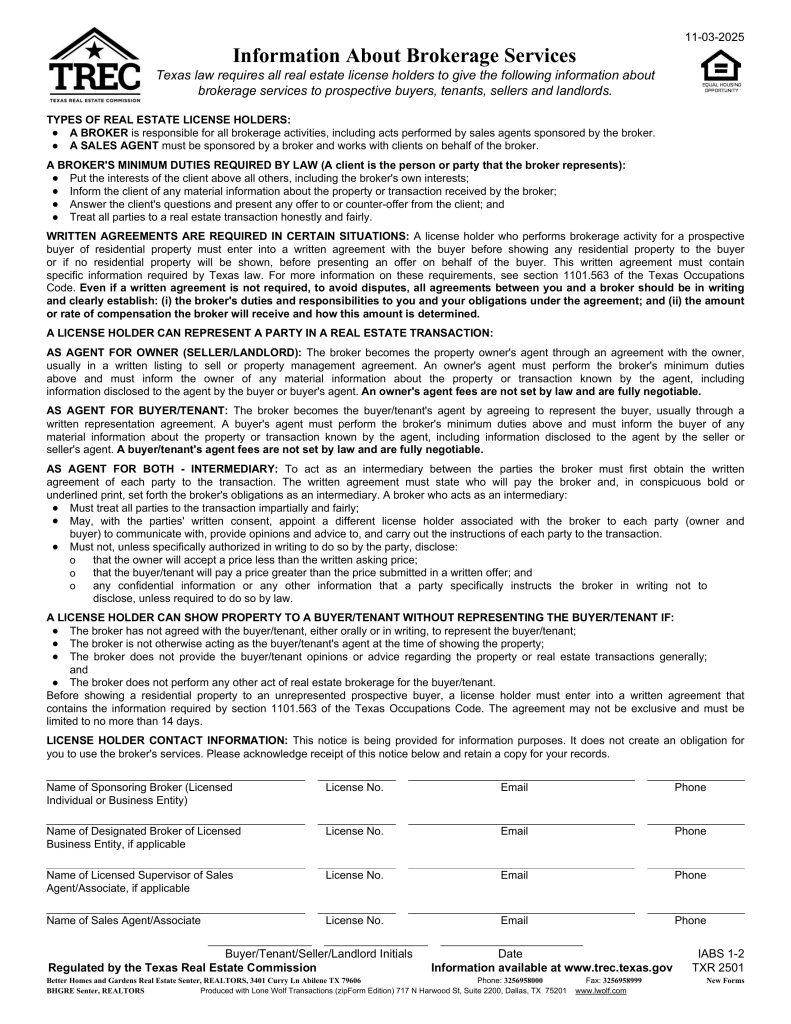
Texas Information About Brokerage Services (IABS). This disclosure explains brokerage relationships and identifies the license holders involved. It is not itself a representation agreement.
There’s another part of this form I think consumers should pay attention to: the contact information at the bottom.
It identifies the brokerage, broker, supervisor when applicable, and sales agent.
That’s important because your representation agreement is ultimately with the broker, not simply the individual sales agent you’re working with.
If a problem develops during a transaction, knowing who supervises the agent and who is ultimately responsible for the brokerage matters.
The IABS is an important disclosure.
But acknowledging it does not lock you into an agent.
So What Paperwork Actually Can?
That’s where a written buyer agreement comes in.
As of January 1, 2026, Texas law requires a written agreement before a real estate license holder shows residential property to a prospective buyer—or, if no property is shown, before presenting an offer on that buyer’s behalf.
That sounds intimidating.
But here’s the part I don’t think enough consumers understand:
You still have options.
The next two images show the short-form buyer representation agreement we use. There are several places where it can be tailored to fit the relationship you’re actually comfortable establishing.
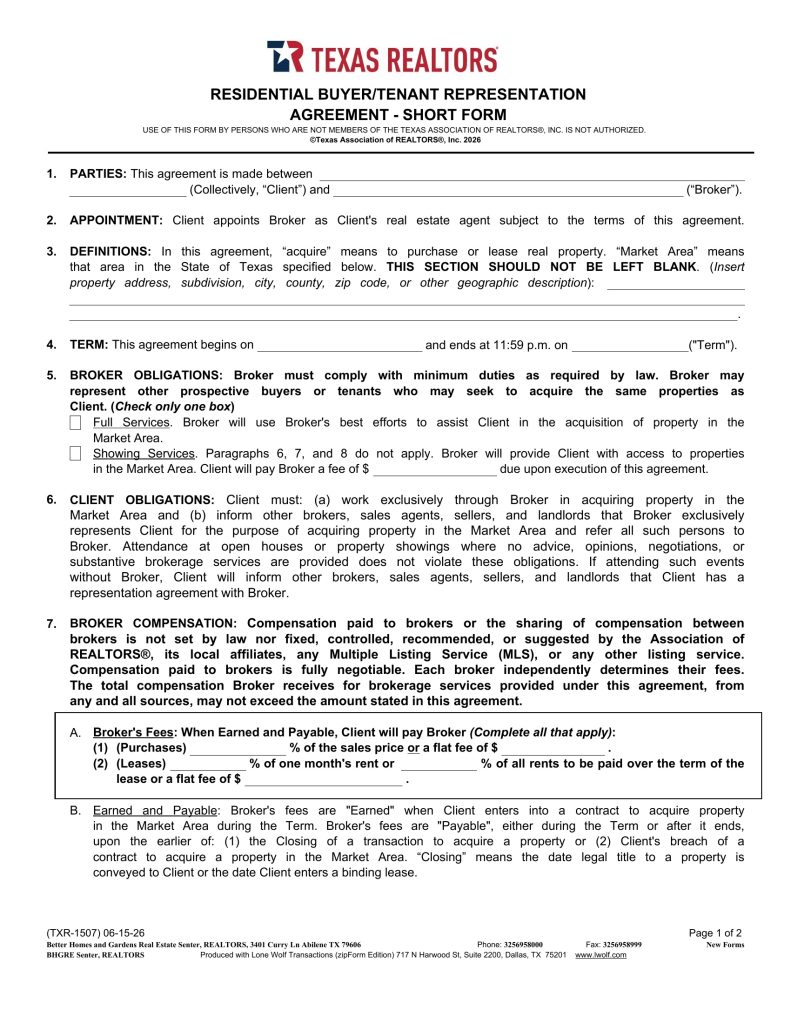
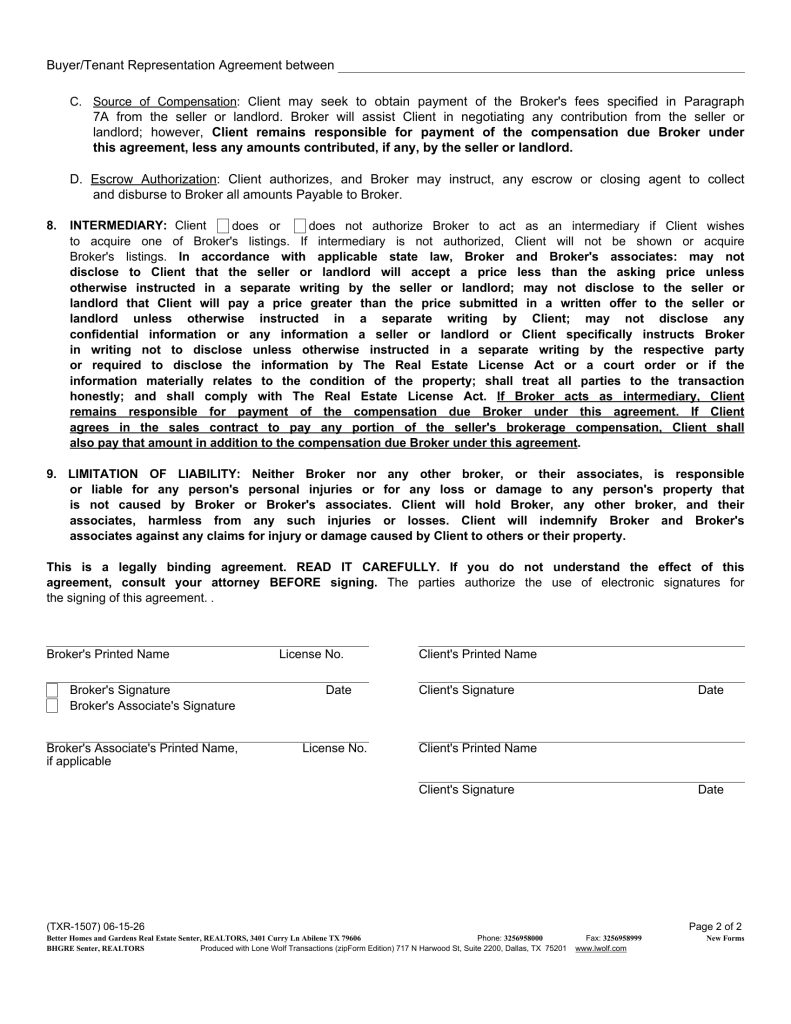
The Texas REALTORS® Residential Buyer/Tenant Representation Agreement – Short Form. Important terms including the market area, length of the agreement, services and compensation can be established within the agreement.
1. You Can Limit What Properties the Agreement Covers
Paragraph 3 defines the Market Area.
That doesn’t necessarily have to mean “all of Abilene,” “Taylor County,” or some enormous geographic area.
It can be as specific as an individual property address.
We do this frequently with investors. If we’re working with an investor on one particular opportunity, we can limit the agreement accordingly instead of unnecessarily tying up everything else that investor is doing.
For other buyers, a broader market area may make perfect sense.
The point is that it’s something you and your broker can discuss—not something you should assume has to be written one particular way.
2. You Can Limit How Long the Agreement Lasts
Paragraph 4 establishes the Term.
That can be months.
It can also be a day or a weekend.
When one of our agents meets a new buyer for the first time, we’re perfectly comfortable making that initial agreement short when appropriate.
Let the agent do their job. Spend some time together. See some houses. Get a feel for how they communicate, what they know and whether you trust their advice.
Then decide whether this is someone you actually want representing you through one of the largest purchases you’ll make.
We’d rather earn the longer relationship than demand it before we’ve earned anything.
3. You Can Choose the Level of Service
The short-form agreement also provides different options for the services a broker will provide.
With full representation, your REALTOR® can do considerably more than unlock doors. They can help you search for properties, evaluate what you’re considering, prepare and negotiate offers, work through inspections and repairs, and help guide the transaction toward closing.
The agreement also establishes how the broker will be compensated.
Real estate commissions are not set by law and are negotiable.
Under our normal full-service model at BHGRE Senter, REALTORS®, our agents may spend hours—or sometimes months—searching, showing properties, researching values, preparing offers, negotiating and working through problems without receiving compensation unless a transaction successfully closes.
That’s part of why a reasonable representation agreement matters for the agent, too.
If an agent is going to dedicate the time and energy you deserve, there should be some assurance that they’ll have the opportunity to be compensated when the job is successfully completed.
What If I Just Want to See a House?
There are options for that, too.
The short form we use provides a limited showing-services option for a flat fee. When that option is selected, the form itself specifies that certain provisions applicable to full representation don’t apply.
Texas law also now permits a separate non-representation showing agreement.
That option allows a license holder to provide access to a residential property without representing you. But there’s an important tradeoff:
They can show you the house, but they can’t act as your advisor.
A license holder working under that type of arrangement can’t provide opinions or advice regarding the property or real estate transactions generally, or perform other acts of brokerage for you.
The agreement must also be non-exclusive and limited to no more than 14 days.
That’s an important distinction for buyers:
Having someone unlock the door and having a REALTOR® representing your interests are not the same service.
Don’t Sign Something You Don’t Understand
Unfortunately, we’ve had a handful of people contact our office because they were unhappy with the agent they chose but felt trapped by an agreement they signed without really understanding it.
These agreements are real contracts. They matter.
That’s why you should understand things like:
- What properties does this agreement cover?
- How long does it last?
- What services am I receiving?
- How will my broker be compensated?
- Is the agreement exclusive?
- What happens if I decide this isn’t the right relationship?
A good REALTOR® shouldn’t be bothered by those questions.
They should be able to answer them.
Our Approach at BHGRE Senter, REALTORS®
At BHGRE Senter, REALTORS®, our approach is pretty simple.
We’ll explain what you’re signing.
We’ll talk through your options.
We’ll be flexible about the property, term and services when that’s appropriate.
And if you’re unhappy working with us, I’m not interested in using a piece of paper to force you to stay.
We’ve been serving Abilene buyers and sellers since 1957. Relationships that last aren’t built by making it difficult for someone to leave. They’re built by doing a good enough job that they choose to stay.
The agreement should protect the relationship—not substitute for having a good one.
The law may require us to put the relationship in writing.
It doesn’t require you to give up your choices.
Our job is still to earn your trust—and then keep earning it.
