Facebook
 X
X
 Pinterest
 Copy Link
Abilene Market Update: September 2026
Abilene Housing Market Update: Higher Prices, Slower Sales
September 2026 | Abilene & the Big Country
If you only looked at September’s median sales price, you’d probably think Abilene’s housing market was booming.
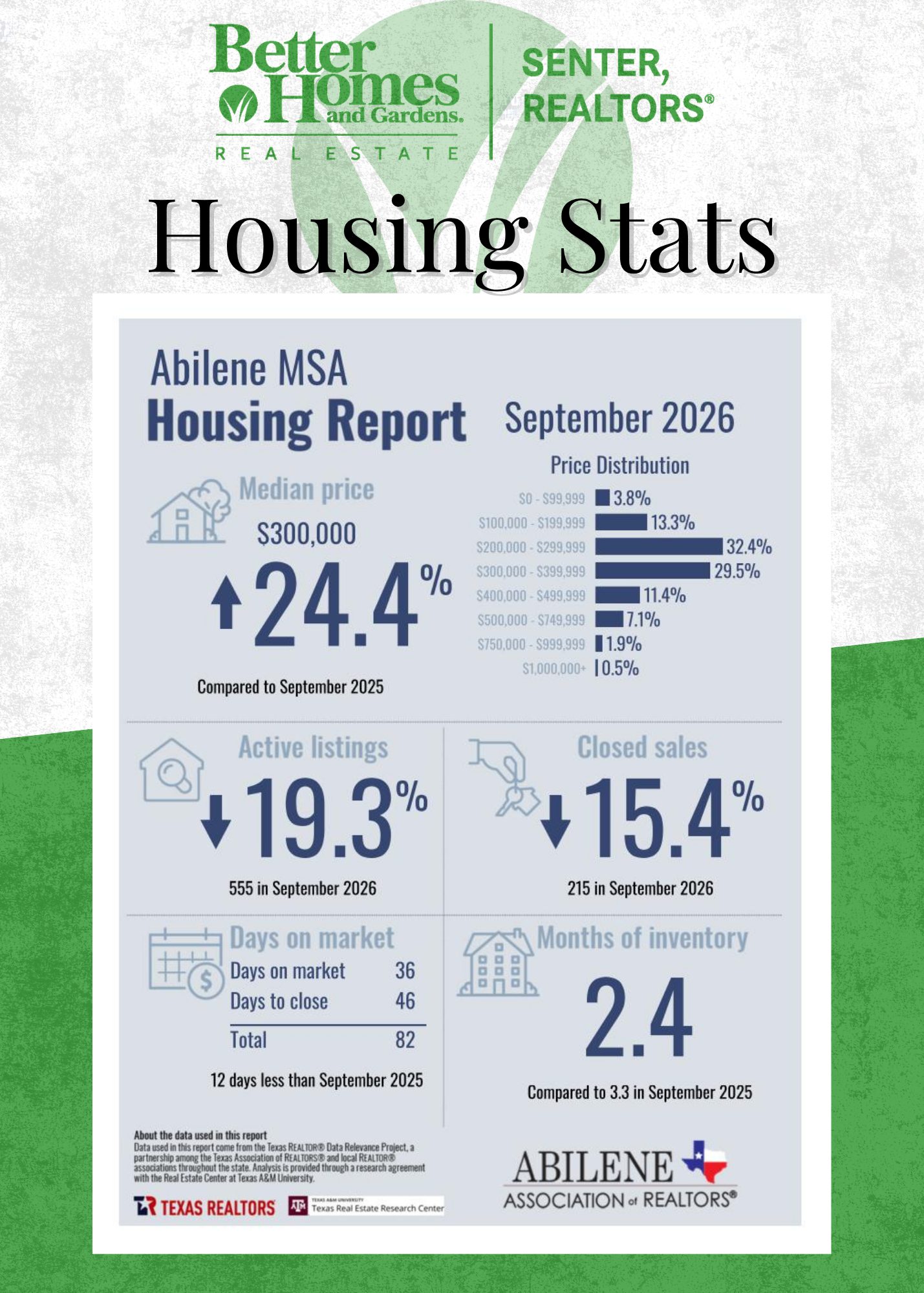
The median reached $300,000, a 24.4% increase over September of last year.
But that’s not really what we’re seeing in the market.
Home sales are down, inventory is down, and mortgage rates have risen sharply in recent weeks. We’re continuing to see a market that’s slowing down, even as the reported median sales price climbs.
September Housing Market Numbers
According to the Abilene Association of REALTORS®:
- Median Sales Price: $300,000, up 24.4%
- Closed Sales: 215, down 15.4%
- Active Listings: 555, down 19.3%
- Days on Market: 36
- Months of Inventory: 2.4, down from 3.3 last year
Why Are Prices Up So Much?
We’ve discussed this in previous market updates, but it’s worth repeating: a 24.4% increase in median sales price doesn’t mean the average home in Abilene is worth 24.4% more than it was a year ago.
The median is heavily influenced by which homes happen to sell during a particular month.
In September, more than half of all sales were above $300,000, while fewer than 17% were below $200,000.
When fewer affordable homes are available and selling, the median naturally moves higher. That doesn’t necessarily reflect a similar increase in the value of individual homes.
We’ve been dealing with limited affordable inventory for quite some time, and that continues to be one of the biggest challenges for buyers in Abilene.
Fewer Sales, But Also Fewer Homes Available
September sales declined 15.4% compared to last year, but active listings fell even further at 19.3%.
That’s an interesting combination.
We have fewer buyers completing purchases, but we also have fewer homeowners putting properties on the market. Inventory remains relatively tight at just 2.4 months.
And as we’ve discussed before, the market looks very different depending on the price range. Affordable homes can still attract significant competition, while higher-priced properties may take longer to sell.
The overall market is slowing, but that doesn’t mean every segment of the market is experiencing the same conditions.
Interest Rates and the Upcoming Election
Mortgage rates have increased sharply over the last several weeks, and I expect that to have a greater impact on the market moving forward.
It’s important to remember that September’s closed sales largely represent contracts negotiated weeks earlier, before much of the recent increase in rates.
Higher rates make homes less affordable for buyers and give existing homeowners with low-rate mortgages another reason to stay put.
We’re also heading into a major election, which can add another layer of hesitation.
In my experience, it’s fairly common for people to put major financial decisions on hold when there’s uncertainty about what’s coming next. And that hesitation isn’t necessarily about which political party wins. Sometimes people simply want the election behind them before making a decision.
I’m hopeful we’ll see some renewed activity once that uncertainty is removed, and perhaps some relief in mortgage rates as well. Of course, interest rates will ultimately depend on broader economic conditions, not simply the election results.
Where Do We Go From Here?
I don’t expect any dramatic changes in Abilene’s housing market overnight.
Affordability remains a challenge, inventory is still limited in important price ranges, and higher interest rates are making things more difficult for buyers.
For sellers, pricing correctly is more important than ever. For buyers, a slower market may create opportunities, particularly with properties that have been sitting on the market longer.
My biggest takeaway from September is that higher median prices don’t necessarily mean a stronger housing market, just as slower sales don’t necessarily mean home values are falling.
There’s a lot more happening beneath the headline numbers, and understanding those differences is what matters when you’re making real estate decisions.
At Better Homes and Gardens Real Estate Senter, REALTORS®, we’ve been helping Abilene families and businesses navigate changing markets since 1957.
Nobody Knows Abilene Better.
The Real Cost of Overpricing Commercial Property
Pricing Commercial Real Estate in Abilene: Sometimes the Best Advice Is the Hardest to Hear
There is a line in the REALTOR® Code of Ethics that I think deserves more attention, especially when we’re talking about commercial real estate.
Standard of Practice 1-3 says:
“REALTORS®, in attempting to secure a listing, shall not deliberately mislead the owner as to market value.”
That’s pretty straightforward.
Our job isn’t to tell a property owner the number most likely to get us hired. Our job is to give them our best professional opinion of what the market will actually support, even when that isn’t the number they were hoping to hear.
That doesn’t mean every broker is going to agree on value. Commercial real estate is rarely that simple. Two experienced brokers can look at the same property, make different assumptions and come to different conclusions.
But there is a big difference between a legitimate difference of opinion and telling someone what they want to hear just to get a sign in front of the building.
And I think that distinction matters.
A Listing Price Still Has to Make Financial Sense
I’ve talked about this before, but it bears repeating:
A listing price only matters if there’s a buyer willing and able to make the numbers work.
For an investment property, that buyer is going to look at rents, expenses, vacancy, repairs, financing, NOI and the return they can reasonably expect.
For an owner-user, the calculation is different, but the basic principle is the same.
A local business owner can’t substantially overpay for a building, spend hundreds of thousands of dollars renovating it, finance the project, buy equipment, hire employees, open the doors and somehow make the economics work just because the seller or listing broker says it’s a “great opportunity.”
It just doesn’t happen, y’all.
There are certainly exceptional properties and locations that can command exceptional prices. But that’s what makes them exceptional. Most properties aren’t. Most commercial properties are competing with other available options, and ultimately the market is going to decide what they’re worth.
Time Isn’t Always on the Seller’s Side
One of the things I hear in commercial real estate is that there isn’t much downside to starting high.
“We can always reduce it later.”
Technically, that’s true.
But the building doesn’t stop aging while we wait.
Roofs age. HVAC systems fail. Plumbing develops problems. Parking lots deteriorate. Water finds places to get in. Vacant spaces aren’t always maintained, heated and cooled the same way occupied spaces are.
Small maintenance issues can become much larger ones.
Empty buildings don’t get better with time.
Meanwhile, the owner is still paying taxes, insurance, utilities, maintenance and whatever other carrying costs come with owning the property.
So yes, you can reduce the price later. But that doesn’t mean waiting was free.
Get Current Numbers
This is one of the biggest things I would encourage commercial property owners to think about right now.
If you haven’t gotten a repair bid recently, don’t assume you know what something costs.
If your building has an older elevator and you haven’t priced elevator work in years, get a current estimate.
If you have an aging fire suppression system, understand its condition and what repairing or updating it could involve.
The same goes for electrical systems, roofs and even something as common as commercial HVAC.
Construction costs have increased substantially over the years, and costs continued moving higher in 2026. ENR’s Building Cost Index was up another 4.3% year over year in March.
But I’m less concerned with any national construction index than I am with what the work is actually going to cost on your building, in Abilene, today.
That’s why the answer is pretty simple:
Get a bid.
Don’t base a decision involving hundreds of thousands or millions of dollars in real estate on what you remember a repair costing 10 or 15 years ago.
And certainly don’t base it on what something cost 20 years ago.
A buyer isn’t going to.
They’re going to look at what it costs today.
Buyers Are Pricing the Property They’re Buying Today
This is where conversations about value can sometimes get uncomfortable.
An owner knows what they paid for a property. They remember what they spent improving it. They may know what a neighboring property is listed for. And they certainly know what they’d like to walk away with.
All of those things are understandable.
But that’s not necessarily what the buyer is evaluating.
The buyer is looking at today’s interest rates, today’s construction costs, today’s insurance, today’s taxes, today’s rents and today’s cost to repair or modernize the property.
If an older commercial building needs substantial work to function for the buyer’s intended use, that doesn’t necessarily mean you subtract those costs dollar-for-dollar from the value.
Real estate doesn’t work that neatly.
But those costs absolutely matter.
And ignoring them doesn’t make them disappear.
Overpricing Can Cost More Than the Eventual Price Reduction
This is the part that sometimes gets lost when a seller decides to “try” an aggressive price.
Suppose the market doesn’t respond.
Six months becomes a year. A year becomes two.
The property remains vacant or underutilized. Taxes and insurance continue. Maintenance continues. Maybe another HVAC unit goes down. Maybe a roof problem develops. Maybe something that could have been repaired relatively easily becomes a much bigger problem.
Eventually, the price gets reduced anyway.
Except now the seller has absorbed the carrying costs, potentially taken on additional repairs and lost a year or two in the process.
That’s why I don’t think good commercial real estate advice is simply about getting a seller to agree to list a property.
A sign in front of the building isn’t the goal. A successful closing is.
Sometimes the Right Number Isn’t the Number You Want to Hear
I understand why these conversations can be difficult.
Commercial properties can represent decades of someone’s work. Owners may have a significant financial and even emotional investment in a building. Expectations can also be influenced by what other properties are listed for, even if those properties haven’t sold.
And if one broker gives an owner a realistic number while another is willing to list it substantially higher, it’s pretty easy to understand which answer sounds better.
But that brings me right back to where we started.
The REALTOR® Code of Ethics says that when we’re trying to secure a listing, we cannot deliberately mislead an owner about market value. Article 1 also says that when representing a client, our obligation is to protect and promote that client’s interests.
Sometimes protecting someone’s interests means telling them something they don’t particularly want to hear.
It may mean recommending a lower asking price.
It may mean telling them we need some current repair bids before we really know where the property stands.
It may mean explaining that an elevator, roof, HVAC system, electrical system or fire suppression issue is going to factor into what a buyer is willing to pay.
And sometimes it may mean telling an owner that I’m simply not the right person to list the property at the price they want.
That’s okay.
I’d rather have an uncomfortable conversation at the beginning than spend the next two years telling someone what they want to hear while their property sits on the market.
The goal isn’t the highest price we can put on a listing. It’s the highest price the market can realistically support.
I think property owners deserve that kind of honesty from the person they’re trusting to advise them.
Abilene Market Update: August 2026
Abilene Housing Market Update: Higher Rates Could Test the Market This Fall
The August housing numbers are out for Abilene, and once again the median sales price is going to get most of the attention.
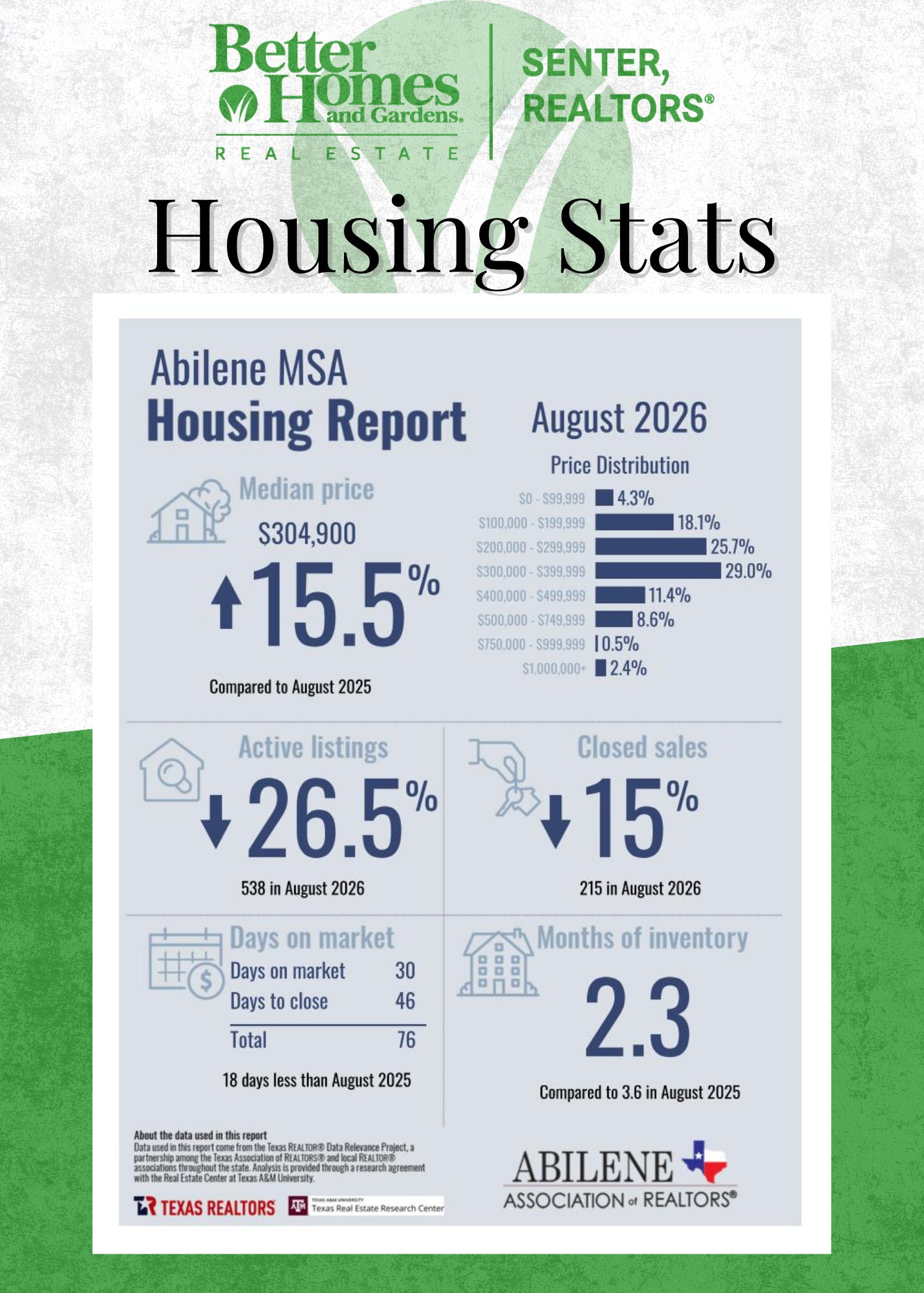
The median price for the Abilene MSA was $304,900 in August, up 15.5% from August 2025.
That’s a big increase. But just like we discussed last month, I don’t think Abilene homes suddenly became 15% more valuable.
August actually gives us more evidence that the mix of homes selling is having a big impact on that number.
The Median Price Is Still High, But It’s Already Come Down
In July, Abilene’s median sales price reached $313,500, up a whopping 26.3% from the year before.
In August, it dropped back to $304,900. That’s about $8,600 lower in one month, while the year-over-year increase fell from 26.3% to 15.5%.
I’ve been talking about this distinction for several months now: an increase in median sales price is not necessarily the same thing as an increase in home values.
The median tells us the middle price of the homes that sold. Change the mix of those homes and you change the median.
When we dug into July’s numbers, we found more sales happening in the $300,000–$500,000 ranges and fewer lower-priced homes making up the total. August still shows quite a bit of that.
Of all August sales:
- 25.7% were between $200,000 and $299,999
- 29.0% were between $300,000 and $399,999
- 22.9% were $400,000 or higher
More than half of the homes sold in August were above $300,000.
That’s a very different statement than saying the typical Abilene home increased 15.5% in value over the last year.
It didn’t.
I’m Watching the Rest of the Numbers More Closely
The median price makes the better headline, but some of the other August numbers probably tell us more about where the market could be headed.
There were 215 closed sales in August, down 15% from last year.
We had 538 active listings and 2.3 months of inventory. That’s still a relatively tight supply of homes, but inventory has moved from 1.8 months in June to 2.2 in July and now 2.3 in August.
Homes averaged 30 days on market before going under contract.
I don’t look at any of that and think the Abilene housing market is in trouble. I do think it’s getting harder to argue that the market is getting hotter simply because the median sales price is higher.
And now we have another factor to deal with.
Mortgage Rates Are Back Around 7%
Mortgage rates have moved in the wrong direction for buyers.
NAR Chief Economist Lawrence Yun reported September 16 that average mortgage rates had risen from around 6% in late February to approximately 7% and said buyers may need to expect 7% as the new normal, at least for now.
The Federal Reserve also raised its target rate by a quarter point on September 16 as inflation continues to be a concern.
The federal funds rate and mortgage rates aren’t the same thing and don’t move together dollar-for-dollar, but the bigger issue for our housing market is pretty simple:
Borrowing money has gotten more expensive again.
For some perspective, on a $250,000 30-year mortgage, the difference between 6% and 7% is roughly $165 per month in principal and interest.
At $300,000, it’s about $200 per month.
Same house. Same purchase price. Just a more expensive payment.
That adds up quickly when buyers are already dealing with higher insurance, property taxes and everyday expenses.
That’s What Has Me More Cautious Heading Into Fall
We’ve had a couple of things working in Abilene’s favor for quite a while: relatively tight inventory and solid demand.
But affordability still matters.
A buyer doesn’t shop based only on the price of a house. They have to be able to afford the payment.
When rates rise, buying power falls. And when that happens at the same time inventory is slowly increasing and sales are slowing, I think it’s worth paying attention.
I’m not predicting some dramatic drop in Abilene home prices. I don’t see anything in these numbers that would justify saying that.
But I also wouldn’t look at a 15.5% year-over-year increase in the median price and assume we’re headed for another big run-up in home values.
We’ve now seen the median fall from July to August. Closed sales were down 15%. Inventory has increased for three straight months. And buyers are once again dealing with mortgage rates around 7%.
That’s enough for me to be more cautious about what we see this fall.
Sellers May Have to Adjust Too
This is where pricing gets really important.
When buyers have very few choices and financing is cheap, sellers can get away with being more aggressive.
Give buyers more choices and a higher monthly payment, and they become a lot less forgiving.
We’re absolutely still seeing homes sell quickly in Abilene. The right home, in the right condition, at the right price can move very quickly.
But that’s not the same market for every house.
Price range matters. Condition matters. Location matters. Competition matters.
If Abilene’s median price is up 15.5%, that does not mean you should take what your house was worth last August and add 15.5%.
That’s just not how this works.
So Where Does That Leave Abilene?
I still think we have a healthy housing market.
2.3 months of inventory is not an oversupplied market. An average of 30 days to get a home under contract isn’t particularly slow either.
But the market is changing.
Inventory is gradually rebuilding. Sales were down in August. Mortgage rates are back around 7%. And the big increases we’ve seen in median sales price continue to have a lot to do with which homes are selling, not simply every house in Abilene suddenly becoming dramatically more valuable.
That’s why I spend so much time digging into these numbers instead of repeating the headline.
Even an Abilene-wide statistic can only tell us so much. What’s happening with a $175,000 house can be completely different from what’s happening at $350,000 or $700,000. One neighborhood can be moving while another one a few miles away is sitting.
Real estate is local, and right now I think the details matter more than the headline.
We’ll keep digging into them each month.
BHGRE Senter, REALTORS®
Serving Abilene and the Big Country since 1957.
325-695-8000 | SenterRealtors.com
Texas Representation Agreements: What Buyers Need to Know

Why Is My REALTOR® Asking Me to Sign a Buyer Agreement in Texas?
What Abilene homebuyers should know about the new requirements—and the choices you still have
If you’ve tried to look at a home recently, you may have encountered something that feels different.
You call a REALTOR® about a property, and before they can show it to you, they’re asking you to sign paperwork.
Yes, Texas law has changed, and some of that paperwork is now required. But required paperwork does not mean you don’t have choices about what you’re agreeing to.
There are several ways these agreements can be structured, and buyers should understand those options before signing anything.
So let’s make these forms a little less intimidating.
First: Information About Brokerage Services
One of the first forms you’re likely to receive is called Information About Brokerage Services, commonly referred to as the IABS.
The biggest thing to understand:
This is not a representation agreement.
You’re not hiring an agent simply by acknowledging receipt of this form. The IABS explains the different ways a Texas real estate license holder can work with you, including representation of a buyer or seller, intermediary relationships, and circumstances in which a property can be shown to an unrepresented buyer.
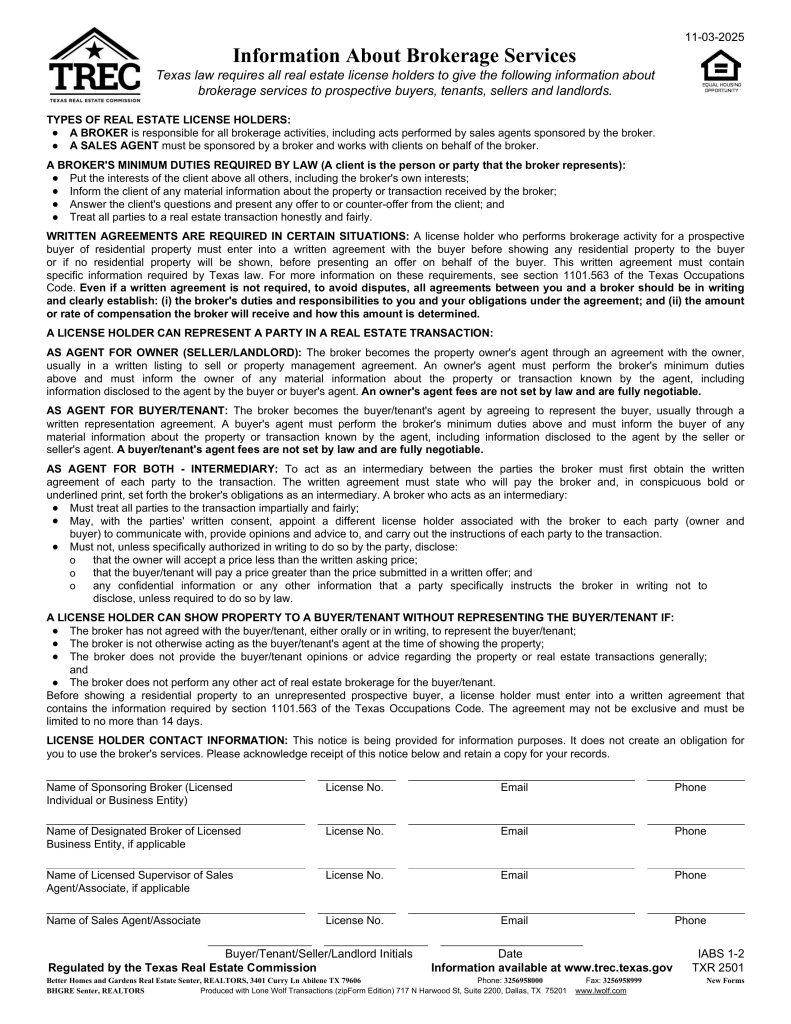
Texas Information About Brokerage Services (IABS). This disclosure explains brokerage relationships and identifies the license holders involved. It is not itself a representation agreement.
There’s another part of this form I think consumers should pay attention to: the contact information at the bottom.
It identifies the brokerage, broker, supervisor when applicable, and sales agent.
That’s important because your representation agreement is ultimately with the broker, not simply the individual sales agent you’re working with.
If a problem develops during a transaction, knowing who supervises the agent and who is ultimately responsible for the brokerage matters.
The IABS is an important disclosure.
But acknowledging it does not lock you into an agent.
So What Paperwork Actually Can?
That’s where a written buyer agreement comes in.
As of January 1, 2026, Texas law requires a written agreement before a real estate license holder shows residential property to a prospective buyer—or, if no property is shown, before presenting an offer on that buyer’s behalf.
That sounds intimidating.
But here’s the part I don’t think enough consumers understand:
You still have options.
The next two images show the short-form buyer representation agreement we use. There are several places where it can be tailored to fit the relationship you’re actually comfortable establishing.
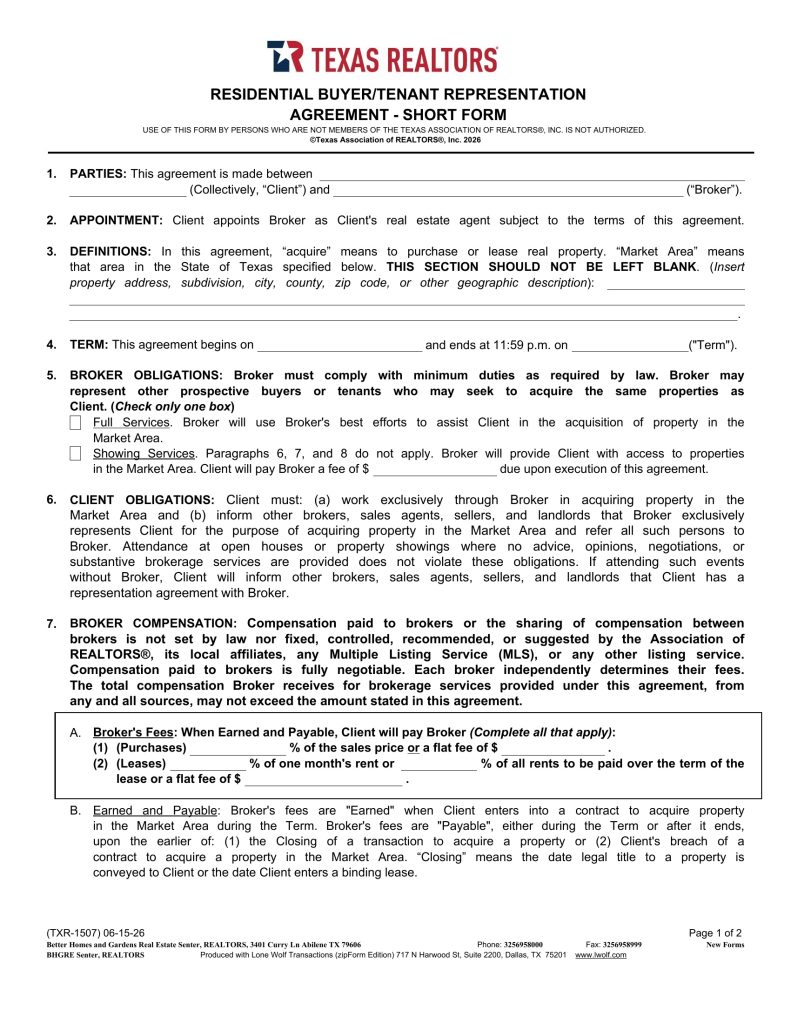
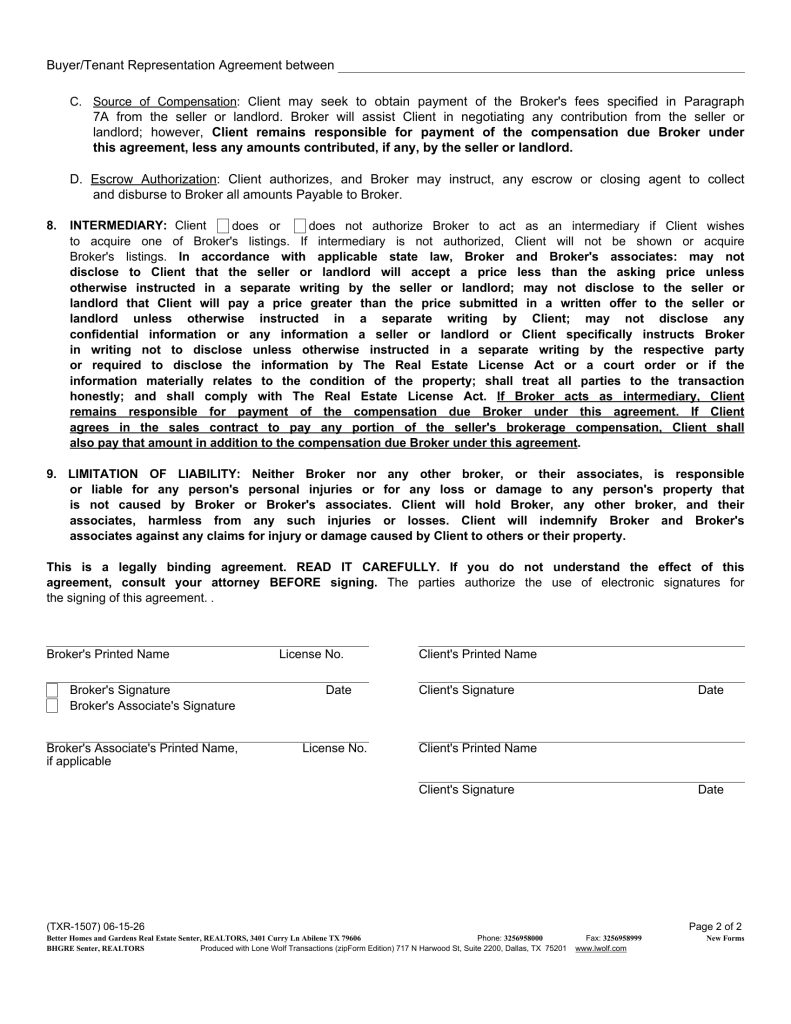
The Texas REALTORS® Residential Buyer/Tenant Representation Agreement – Short Form. Important terms including the market area, length of the agreement, services and compensation can be established within the agreement.
1. You Can Limit What Properties the Agreement Covers
Paragraph 3 defines the Market Area.
That doesn’t necessarily have to mean “all of Abilene,” “Taylor County,” or some enormous geographic area.
It can be as specific as an individual property address.
We do this frequently with investors. If we’re working with an investor on one particular opportunity, we can limit the agreement accordingly instead of unnecessarily tying up everything else that investor is doing.
For other buyers, a broader market area may make perfect sense.
The point is that it’s something you and your broker can discuss—not something you should assume has to be written one particular way.
2. You Can Limit How Long the Agreement Lasts
Paragraph 4 establishes the Term.
That can be months.
It can also be a day or a weekend.
When one of our agents meets a new buyer for the first time, we’re perfectly comfortable making that initial agreement short when appropriate.
Let the agent do their job. Spend some time together. See some houses. Get a feel for how they communicate, what they know and whether you trust their advice.
Then decide whether this is someone you actually want representing you through one of the largest purchases you’ll make.
We’d rather earn the longer relationship than demand it before we’ve earned anything.
3. You Can Choose the Level of Service
The short-form agreement also provides different options for the services a broker will provide.
With full representation, your REALTOR® can do considerably more than unlock doors. They can help you search for properties, evaluate what you’re considering, prepare and negotiate offers, work through inspections and repairs, and help guide the transaction toward closing.
The agreement also establishes how the broker will be compensated.
Real estate commissions are not set by law and are negotiable.
Under our normal full-service model at BHGRE Senter, REALTORS®, our agents may spend hours—or sometimes months—searching, showing properties, researching values, preparing offers, negotiating and working through problems without receiving compensation unless a transaction successfully closes.
That’s part of why a reasonable representation agreement matters for the agent, too.
If an agent is going to dedicate the time and energy you deserve, there should be some assurance that they’ll have the opportunity to be compensated when the job is successfully completed.
What If I Just Want to See a House?
There are options for that, too.
The short form we use provides a limited showing-services option for a flat fee. When that option is selected, the form itself specifies that certain provisions applicable to full representation don’t apply.
Texas law also now permits a separate non-representation showing agreement.
That option allows a license holder to provide access to a residential property without representing you. But there’s an important tradeoff:
They can show you the house, but they can’t act as your advisor.
A license holder working under that type of arrangement can’t provide opinions or advice regarding the property or real estate transactions generally, or perform other acts of brokerage for you.
The agreement must also be non-exclusive and limited to no more than 14 days.
That’s an important distinction for buyers:
Having someone unlock the door and having a REALTOR® representing your interests are not the same service.
Don’t Sign Something You Don’t Understand
Unfortunately, we’ve had a handful of people contact our office because they were unhappy with the agent they chose but felt trapped by an agreement they signed without really understanding it.
These agreements are real contracts. They matter.
That’s why you should understand things like:
- What properties does this agreement cover?
- How long does it last?
- What services am I receiving?
- How will my broker be compensated?
- Is the agreement exclusive?
- What happens if I decide this isn’t the right relationship?
A good REALTOR® shouldn’t be bothered by those questions.
They should be able to answer them.
Our Approach at BHGRE Senter, REALTORS®
At BHGRE Senter, REALTORS®, our approach is pretty simple.
We’ll explain what you’re signing.
We’ll talk through your options.
We’ll be flexible about the property, term and services when that’s appropriate.
And if you’re unhappy working with us, I’m not interested in using a piece of paper to force you to stay.
We’ve been serving Abilene buyers and sellers since 1957. Relationships that last aren’t built by making it difficult for someone to leave. They’re built by doing a good enough job that they choose to stay.
The agreement should protect the relationship—not substitute for having a good one.
The law may require us to put the relationship in writing.
It doesn’t require you to give up your choices.
Our job is still to earn your trust—and then keep earning it.
Abilene Market Update: July 2026
Did Abilene Home Prices Really Jump 26%? Here’s What July’s Numbers Actually Mean
There is one number in the July 2026 Abilene housing report that is going to get a lot of attention.
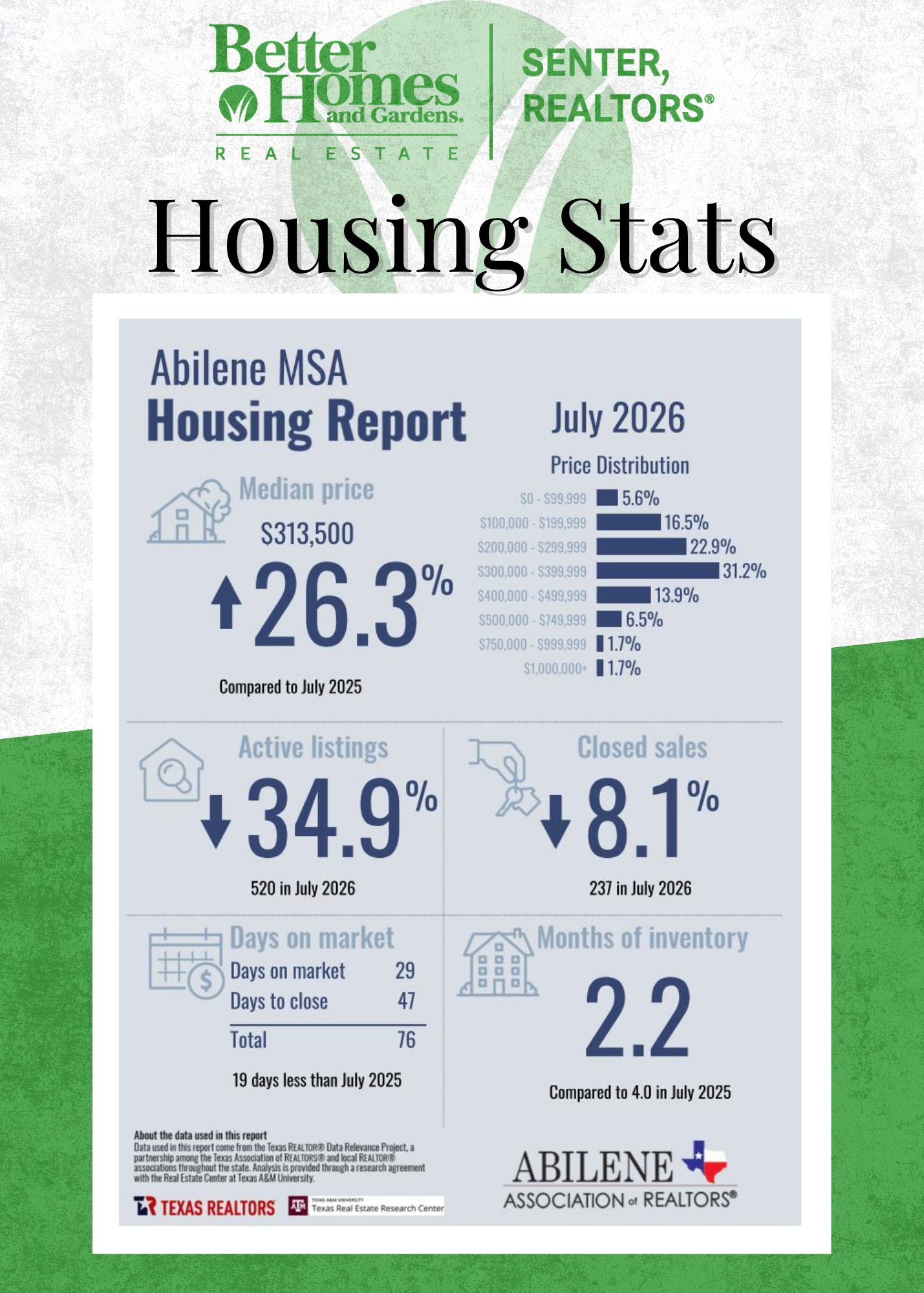
The median sales price reached $313,500, up 26.3% from July of last year.
That’s a pretty remarkable number, especially considering the median price was $255,000 in April and $274,995 in June.
So, have Abilene home values really jumped more than 20% in just a few months?
No. But there is an interesting story behind the increase.
The biggest thing to understand is that median sales price tells us what sold. It doesn’t necessarily tell us how much the value of an individual home changed.
And what sold in July looked quite a bit different from what we’ve been seeing.
First, What Does a $313,500 Median Actually Mean?
Median price is simply the midpoint of all the homes that sold during the month.
If you lined up every sale from least expensive to most expensive, the sale in the middle would give you the median.
That makes it a useful measure of the market, but it is also heavily influenced by the mix of homes that happen to sell in a particular month.
If more $400,000 homes sell and fewer $200,000 homes sell, the median goes up.
That can happen even if the value of the individual homes themselves hasn’t changed much at all.
And that’s a big part of what happened in July.
A Lot More of July’s Sales Were Above $300,000
This is probably the most striking change in the July report.
In June, 57.2% of Abilene MSA sales were below $300,000.
In July, that dropped all the way to 45.0%.
At the same time, several of the higher price ranges gained a much larger share of the month’s sales:
| Price Range | June 2026 | July 2026 |
|---|---|---|
| Under $300,000 | 57.2% | 45.0% |
| $300,000–$399,999 | 25.2% | 31.2% |
| $400,000–$499,999 | 9.8% | 13.9% |
| $500,000–$749,999 | 5.9% | 6.5% |
The $300,000–$499,999 ranges alone accounted for 45.1% of July sales, compared with 35.0% in June.
That’s a major shift in just one month.
And when almost half of your sales are suddenly occurring between $300,000 and $500,000, while the percentage below $300,000 drops significantly, the midpoint is naturally going to move higher.
The Homes That Sold Were Bigger, Too
The detailed MLS sales data gives us another clue about what changed.
The average home sold in Taylor County during June was approximately 1,797 square feet.
In July, it was 1,982 square feet.
That’s an increase of roughly 10% in the size of the average home sold from one month to the next.
The median tells a similar story. Median square footage increased from approximately 1,657 square feet in June to 1,777 square feet in July.
That’s important.
We’re not comparing the prices from the Taylor County data to the MSA report here. We’re simply looking at the characteristics of the homes that were actually changing hands.
And in July, buyers were purchasing larger homes.
A month with more larger homes reaching the closing table is naturally going to produce a different median sales price than a month with more smaller homes.
New Construction Was Part of the Story, But Not Because There Was More of It
New construction has been a major part of the Abilene market, so I was particularly interested in what the detailed sales data showed there.
And this is where things get interesting.
There were actually fewer homes built in 2026 that closed in July than in June.
Our Taylor County MLS data showed 61 sales of 2026-built homes in June compared with 41 in July.
So we can’t simply point to a surge in new construction and say that’s what caused the July number.
The new homes weren’t suddenly much larger, either.
The average 2026-built home sold was approximately 1,729 square feet in June and 1,719 square feet in July. Median size actually declined from about 1,650 to 1,573 square feet.
In other words, the new-construction product itself didn’t suddenly become substantially larger.
What we did see in the MSA report was a broader shift toward sales in higher price brackets, particularly the $300,000s.
That distinction matters because there wasn’t one single thing that caused July’s median to jump. The entire mix of what reached the closing table changed.
July Wasn’t a Market Where Buyers Suddenly Ran Out of Choices
Here’s another reason I wouldn’t look at the $313,500 median and conclude that Abilene home values suddenly took off.
Inventory actually increased.
The Abilene MSA had 426 active listings in June.
July had 520.
That’s 94 additional homes on the market in one month.
Meanwhile, closed sales went the opposite direction. June recorded 313 sales compared with 237 in July, a decline of 76 sales.
Months of inventory increased from 1.8 to 2.2 months as well.
So we had:
More homes for sale. Fewer homes selling. But a much higher median sales price.
At first glance, those things may seem contradictory.
They make considerably more sense once you look at the mix of homes that actually sold.
This Is Why One Month Doesn’t Establish the Value of Your Home
None of this is to say Abilene home values aren’t changing.
They are.
We’ve seen some encouraging pricing data this year, and different parts of the Abilene market continue to perform very differently.
But a 26.3% increase in the monthly median does not mean the average homeowner in Abilene suddenly gained 26.3% in property value.
July had a very different sales mix.
Fewer of the month’s sales occurred below $300,000. More occurred between $300,000 and $500,000. The homes that sold were larger. Meanwhile, overall sales volume declined while the number of homes available for sale increased.
Put all of that together and a much higher median starts making sense.
What Does This Mean If You’re Buying or Selling?
This is where market-wide statistics have their limits.
If you own a $225,000 home, the market for your property can look very different from the market for a $450,000 home.
The same is true for buyers.
Competition, inventory, days on market and negotiating leverage can change substantially depending on the neighborhood and price range you’re looking in.
That’s why we spend so much time looking beyond the headline numbers.
The numbers matter. Understanding what’s behind the numbers matters even more.
If you’re considering buying or selling in Abilene, we’d be happy to help you understand what’s happening in the part of the market that actually matters to you.
Better Homes and Gardens Real Estate Senter, REALTORS®
Serving Abilene and the Big Country since 1957.
Nobody Knows Homes Better.
Abilene Market Update: June 2026
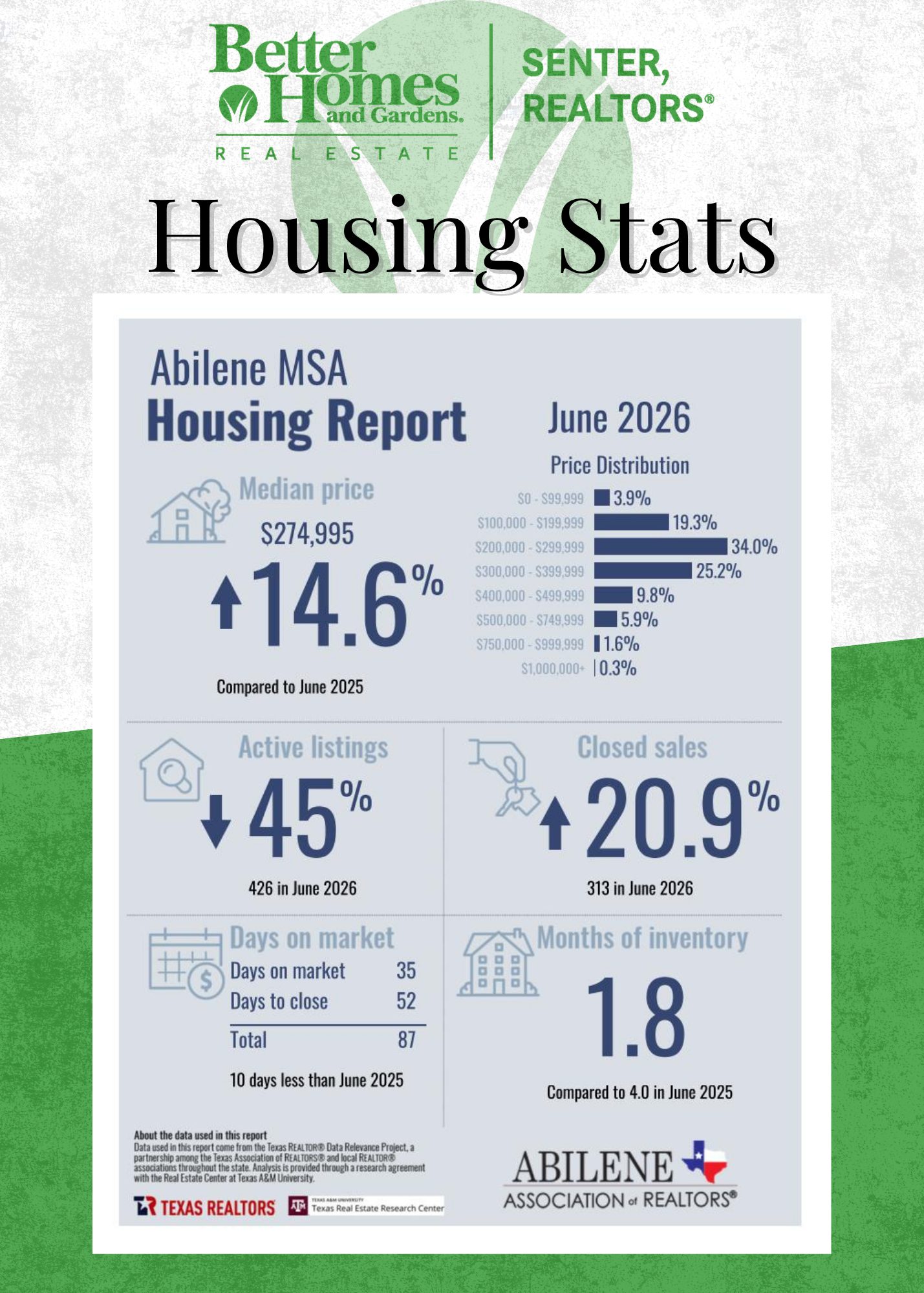
Abilene Housing Market Update – June 2026
If you’ve been following our market updates over the past year, you’ve probably noticed a recurring theme: demand continues to outpace supply.
That was still true in June.
Home prices continued to rise, inventory remains well below historical norms, and buyers are still competing for quality homes in many price ranges. At the same time, there are a few signs that conditions may be moving in a healthier direction than we’ve seen over the past several months.
Prices Continue to Move Higher
The median home price in the Abilene MSA reached $274,995 in June, up 14.6% from June 2025.
That’s a significant year-over-year increase, but it shouldn’t come as a surprise given the inventory challenges we’ve been discussing for much of the past year.
When there aren’t enough homes available to meet buyer demand, prices tend to move higher. That’s exactly what we’ve been seeing.
The encouraging news is that inventory showed some improvement this month.
Inventory Climbs Back Above 400 Homes
The market finished June with 426 active listings.
While that’s still 45% lower than June of last year, it’s also the first time in several months that inventory has climbed back above the 400-home mark.
By itself, that doesn’t solve our inventory shortage. We’re still operating with far fewer homes available than we’d like to see. But it’s a positive step.
It’s also worth noting that June 2025 was the point where inventory began declining sharply. As we moved through the second half of last year, the gap between available inventory and buyer demand continued to widen.
Today we’re still behind last year’s levels, but the gap has started to narrow compared to the healthiest inventory levels we saw during 2025.
It’s too early to call it a trend, but it’s certainly something worth watching.
Buyers Are Still Active
Closed sales increased 20.9% compared to June 2025, with 313 homes closing during the month.
That tells us buyers haven’t disappeared despite higher prices and affordability concerns.
In fact, we’re continuing to see strong activity whenever a home is priced correctly and positioned well in the market.
For buyers, inventory remains the biggest challenge. Many are finding themselves qualified to purchase but struggling to find enough options that fit their needs.
A Closer Look at the $300,000-$400,000 Market
One of the more interesting statistics this month comes from the price distribution data.
Homes priced between $300,000 and $399,999 represented 25.2% of all sales in June, marking one of the largest market shares this price range has captured in recent years.
At first glance, that might suggest buyers are becoming increasingly active throughout the entire $300,000-$400,000 segment. However, when we take a closer look at the local MLS data, a different story emerges.
Approximately 65% of those sales occurred between $300,000 and $350,000 rather than being spread evenly across the entire price range.
That distinction matters.
What we’re really seeing is continued upward pressure on pricing. Many homes that would have fallen into the upper $200,000 range several years ago are now selling in the low-to-mid $300,000s.
So while the $300,000-$400,000 segment is capturing a larger share of the market, much of that activity remains concentrated in the lower half of the range.
Homes Are Still Moving Quickly
The average days on market fell to 35 days, down from 45 days a year ago.
That’s another reminder that despite higher prices, demand remains healthy for well-priced homes.
We’re still seeing many of the same patterns we’ve discussed throughout the year:
- Homes priced appropriately continue to attract strong interest.
- Buyers remain sensitive to condition and presentation.
- Overpriced listings generally sit longer and require price adjustments.
- Inventory is improving, but buyers still don’t have an abundance of choices.
What We’re Watching
The biggest number I’ll be watching over the next few months isn’t price—it’s inventory.
Prices tend to be a lagging indicator. Inventory often gives us a much earlier look at where the market may be headed.
Seeing active listings climb back above 400 is encouraging, especially after several months of extremely limited supply. If inventory continues to improve, buyers could gain more options and some of the upward pressure on prices may begin to ease.
For now, however, the story remains largely the same.
Demand is strong. Inventory is limited. Prices continue to rise.
The difference this month is that we’re finally seeing a few early signs that the inventory side of the equation may be starting to improve.
June 2026 Abilene MSA Housing Statistics
- Median Price: $274,995 (+14.6%)
- Active Listings: 426 (-45.0%)
- Closed Sales: 313 (+20.9%)
- Days on Market: 35
- Months of Inventory: 1.8
Data provided by the Abilene Association of REALTORS® and the Texas REALTORS® Data Relevance Project.
Properties Don’t Sell Because They’re Online
Properties Don’t Sell Because They’re Online
If you’ve bought or sold real estate in the last twenty years, you’ve probably spent time browsing properties online.
Maybe it was Zillow. Maybe Realtor.com. Maybe LoopNet. Maybe a brokerage website or social media post.
The internet has changed the way buyers search for real estate, and that’s generally been a good thing. Information is easier to access than ever before. Buyers can view photos, compare properties, research neighborhoods, and explore opportunities without ever leaving their couch.
But over the years, I’ve noticed a common misconception.
Many people have come to believe that getting a property online is what gets it sold. The reality is that getting a property online is often the easiest part of the entire process.
Getting it to the closing table is where the real work begins.
Exposure Is Important. It’s Just Not Everything.
Twenty or thirty years ago, exposure was one of the biggest challenges in real estate.
Today, most properties receive plenty of it.
A property listed in the MLS is typically distributed across numerous websites and search platforms. Commercial properties can appear on industry-specific websites, brokerage websites, search engines, email campaigns, and social media. Information travels quickly.
The truth is that buyers have never had more ways to discover available properties. That’s why I’ve always found it interesting when people focus almost exclusively on where a property is being displayed.
Visibility matters. But visibility alone doesn’t create a sale. If it did, every property with professional photos and an online listing would sell quickly. We all know that’s not how real estate works.
What Happens After Someone Finds the Property?
This is the part that often gets overlooked.
A buyer sees a property online and becomes interested. Great.
Now what?
They have questions.
They want to schedule a showing.
They want to understand the market.
They want to know how the property compares to other options.
They want to know whether the asking price makes sense.
If they decide to move forward, there are contracts, inspections, financing, appraisals, title work, negotiations, deadlines, and countless details that have to be managed along the way.
The website didn’t solve those problems. People did.
One of the biggest mistakes I see is confusing exposure with representation. They’re not the same thing.
Exposure helps buyers find a property. Representation helps buyers and sellers successfully complete a transaction.
Real Estate Is Still a Relationship Business
Technology has changed dramatically during our company’s history.
Senter, REALTORS® was founded in 1957. Since then, we’ve gone from newspaper advertisements and printed listing books to websites, mobile apps, virtual tours, and AI-powered search tools.
The tools have changed. The fundamentals really haven’t.
Real estate is still a people business.
Buyers want confidence in their decisions. Sellers want confidence that someone is looking out for their interests. Transactions move forward when people communicate, solve problems, answer questions, and build trust.
The best technology in the world doesn’t replace those things.
Commercial Real Estate Offers a Good Example
This is especially true in commercial real estate.
Over the years, our commercial team has closed hundreds of transactions throughout the Big Country.
Some came through relationships. Some came through agent networks. Some came through direct conversations between business owners, investors, and professionals who understood the market.
In many cases, the most important part of the transaction wasn’t where the property was advertised. It was having someone available who could explain the opportunity, answer questions, provide market insight, and connect the right buyer with the right property.
Commercial buyers often want more than a listing description. They want context. They want to understand the story behind the property.
That’s difficult for a website to provide.
The Same Principle Applies to Homes
Residential real estate works much the same way.
A buyer may discover a home online, but the decision to purchase that home rarely comes from the listing itself. It comes from the confidence they gain throughout the process.
Confidence in the property. Confidence in the neighborhood. Confidence in the price. Confidence that they’re making a good decision.
Those things are built through conversations, guidance, and experience. Not simply by appearing on a website.
If the Major Portals Disappeared Tomorrow
This may sound strange coming from someone in the real estate business, but if Zillow or LoopNet disappeared tomorrow, real estate transactions would continue.
Buyers would still need homes.
Businesses would still need locations.
Investors would still be looking for opportunities.
New platforms would emerge. Existing platforms would adapt. The industry would move forward just like it always has. The websites matter. The technology matters. The exposure matters.
But none of them are a substitute for experience, communication, and representation.
Don’t Confuse Visibility With Results
The internet has made real estate more visible than ever before, and that’s a positive thing for buyers and sellers alike.
But visibility is only the beginning. Getting a property online is easier than it has ever been. Getting it sold requires much more than that. Successful transactions are built on pricing, presentation, communication, negotiation, and consistent follow-through. The websites help buyers discover opportunities. The people involved help turn interest into a successful closing.
After nearly 70 years of serving Abilene and the surrounding communities, that’s one lesson we’ve seen proven over and over again.
Properties don’t close themselves.
People get them to the closing table.
Abilene Market Update: May 2026
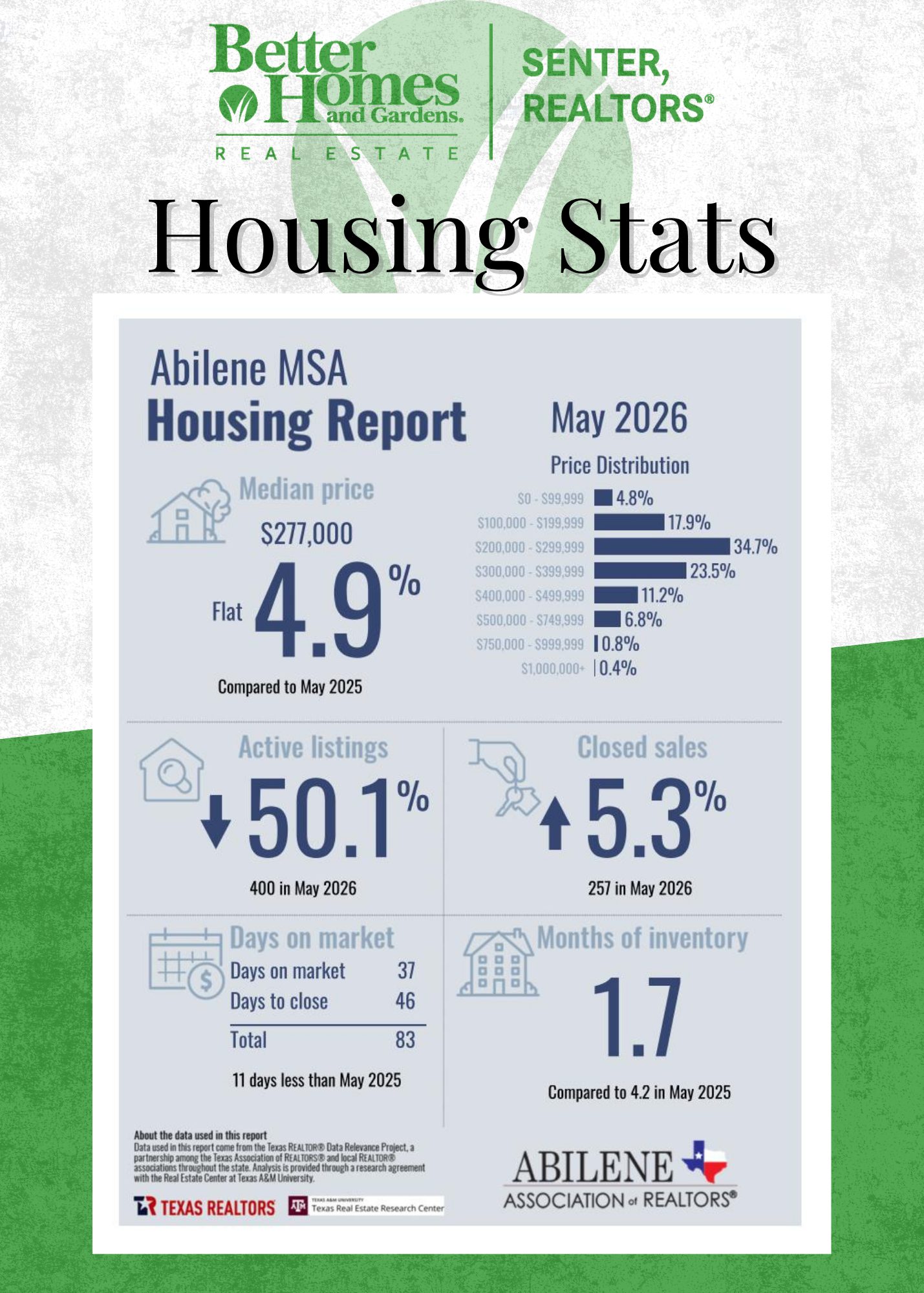
Abilene Housing Market Update: Tight Inventory Finally Pushes Prices Higher
One thing I’ve learned over the years is that housing markets are rarely as simple as they seem.
The latest numbers from the Abilene MSA tell an interesting story.
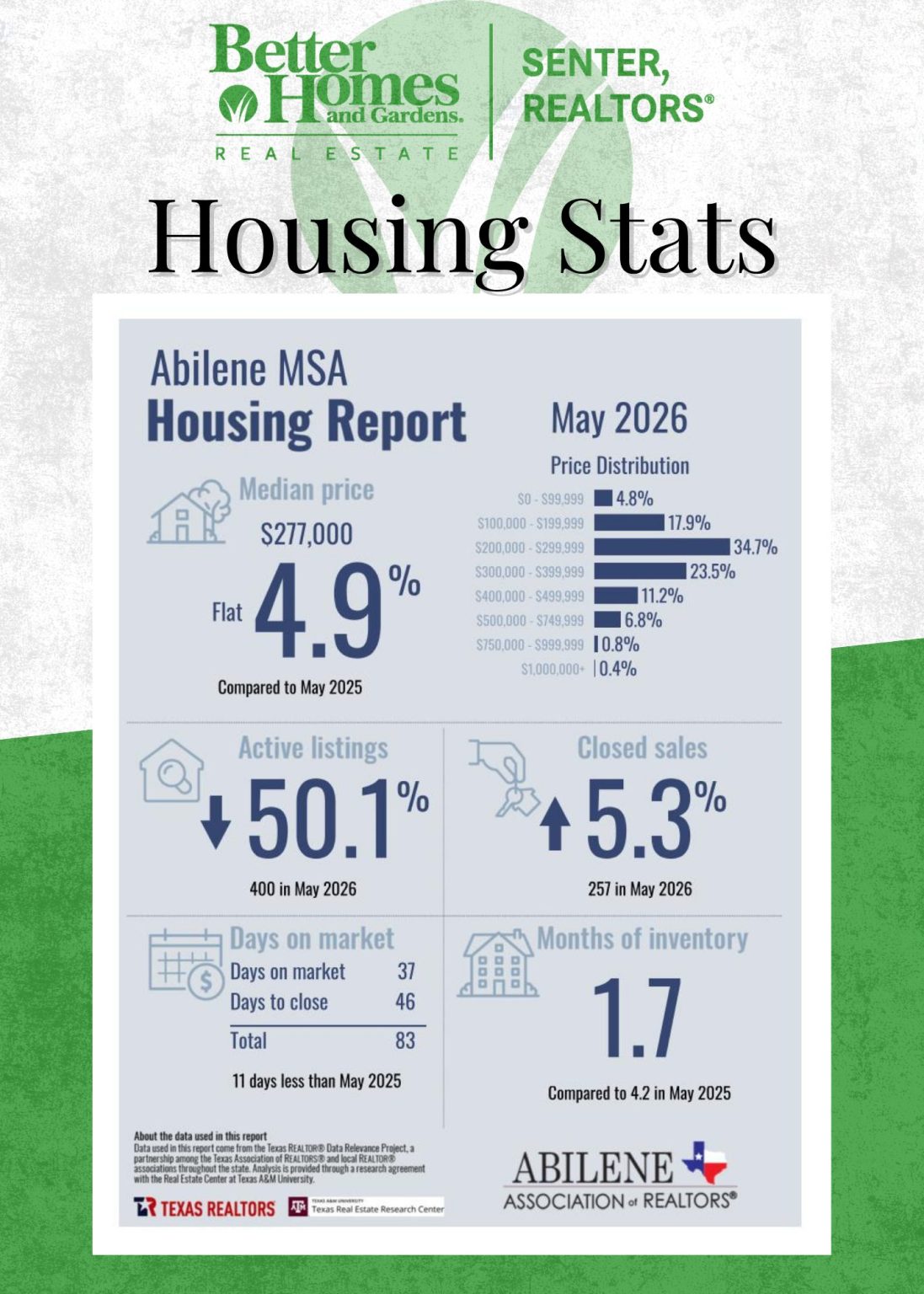
The median home price reached $277,000 in May, up 4.9% from May 2025.
We’ve seen larger percentage increases show up in monthly reports before, so I don’t want to overstate the number. Many of those spikes were driven by outlier months or changes in the mix of homes that happened to sell during a given period.
What stands out to me is the raw median price itself. For much of the last two years, the market has generally hovered closer to the mid-$250,000 range. Seeing that number move to $277,000 is one of the strongest indications we’ve had in quite some time that low inventory is finally beginning to push prices higher.
The question is why.
The $200,000-$350,000 Market Remains Extremely Competitive
If you’ve been actively shopping for a home in Abilene, especially between $200,000 and $350,000, these numbers probably don’t surprise you.
That segment of the market remains incredibly competitive.
Well-priced homes frequently receive multiple offers, and bidding wars are still common. Buyers often find themselves making quick decisions because they know another buyer may be waiting right behind them.
The broader market data supports that reality:
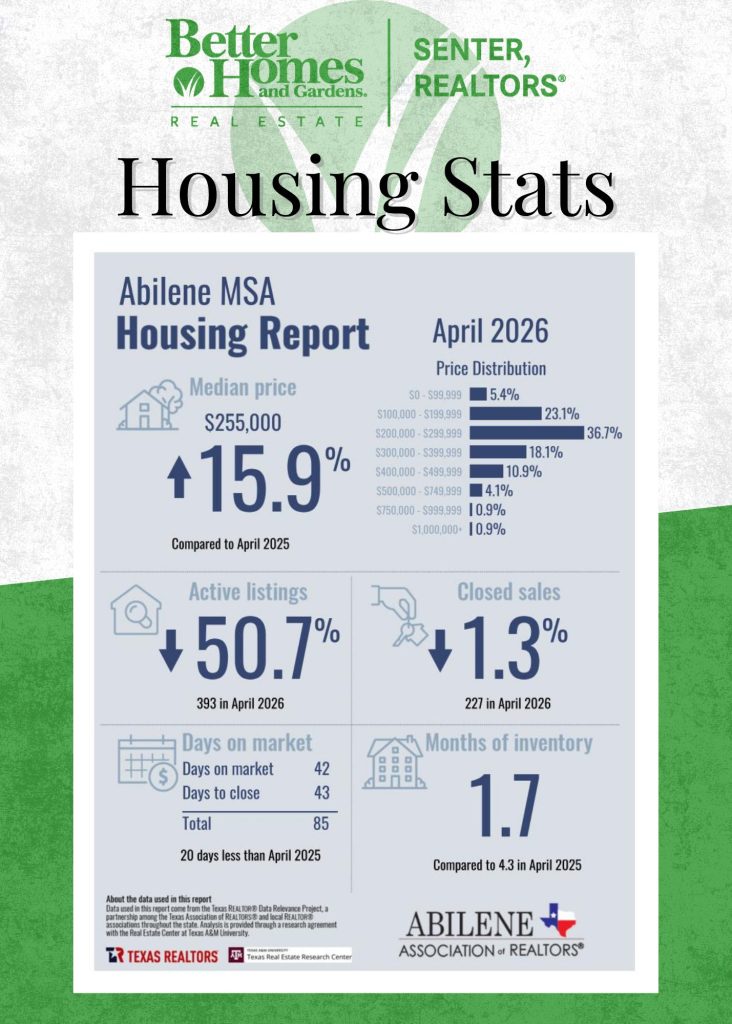
- Active listings are down more than 50% from a year ago.
- Months of inventory sits at just 1.7 months.
- Homes are selling faster than they were this time last year.
Simply put, there still aren’t enough homes available to meet demand.
While some higher price ranges have become more balanced, the middle of the market continues to be highly competitive.
Not Every Buyer Is Competing on Equal Ground
One thing we continue to see is that financing matters.
Conventional and cash buyers often have more flexibility when competing for homes.
Meanwhile, FHA and VA buyers can face additional hurdles due to appraisal requirements, property condition standards, and seller concerns about potential delays.
That doesn’t mean FHA and VA buyers can’t win. They absolutely can and do.
But when a seller is comparing multiple offers, those additional requirements can sometimes make the path more challenging.
That’s why preparation, realistic expectations, and strong representation matter so much in today’s market.
Housing Affordability Is Complicated
Housing affordability is a real challenge for many families right now.
I don’t think anyone looking at today’s interest rates, insurance costs, property taxes, and home prices would argue otherwise.
At the same time, Abilene remains one of the more affordable housing markets in Texas when local incomes are compared to local home prices.
Both of those statements are true.
For some households, homeownership feels further away than it did a few years ago.
For others, the biggest challenge isn’t qualifying for a mortgage—it’s finding the right house before someone else does.
That’s why I usually caution people against broad statements about the housing market. The reality is often more nuanced than the conversation surrounding it.
Affordability challenges are real, particularly for households below the area’s median income. But compared to many Texas communities, Abilene remains in a relatively strong position.
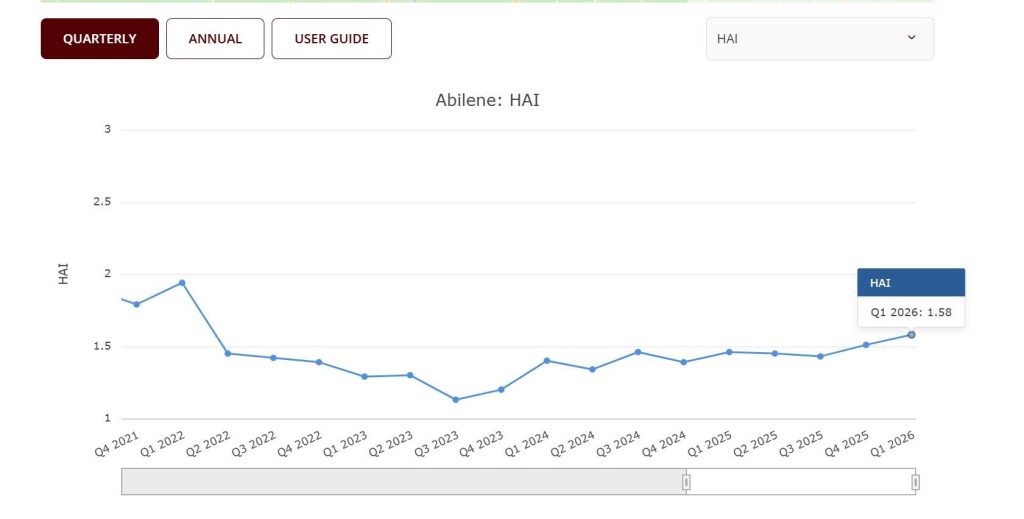
Why Has Inventory Stayed So Tight?
One of the more interesting questions today is why inventory remains so limited despite rising prices.
Part of the answer is simple: there still aren’t enough homes being listed for sale.
But I think there are several factors contributing to the shortage.
Strong rental demand over the last several years has encouraged some property owners to hold onto homes that might otherwise have been sold. In many cases, landlords have found it more attractive to continue renting properties rather than bringing them to market.
We’ve also seen homeowners who moved out of their previous residence choose to rent it rather than sell it. With rental rates remaining strong, some owners have decided to take advantage of the opportunity while they wait to see how the market develops.
Individually, those decisions make sense.
Collectively, they remove housing inventory from the resale market and contribute to the shortage buyers are experiencing today.
Could Balance Return Sooner Than People Expect?
I think it’s possible.
Several of the AI-related data center projects currently under construction have brought a significant temporary workforce into our market. Over the next 18 to 24 months, much of that workforce is expected to taper off as construction progresses and projects move toward completion.
At the same time, many of the housing impacts associated with future growth at Dyess Air Force Base still appear to be several years away.
If some temporary demand begins to ease while additional inventory returns to the market, conditions could start moving toward a healthier balance.
That doesn’t mean prices are about to decline dramatically.
It doesn’t mean inventory problems disappear overnight.
But it does mean that today’s extremely tight market conditions may not be permanent.
In fact, I think there’s a reasonable argument that relief could come sooner than many people expect.
Final Thoughts
The May housing numbers tell a fairly straightforward story.
Inventory remains extremely low.
Competition remains strong, especially between $200,000 and $350,000.
Prices are finally showing meaningful upward movement.
And while affordability challenges are real, Abilene continues to compare favorably with much of Texas when local incomes are measured against local home prices.
As always, I think the most important lesson is to avoid oversimplifying the market.
Two things can be true at the same time.
Housing affordability can be challenging.
And Abilene can still be one of the more affordable housing markets in Texas.
The details matter, and local data continues to tell a much more complete story than any single statistic ever will.
Abilene Eats: Senter Favorites

Where Our Agents Love to Eat in Abilene
One of the best parts of living and working in Abilene is the local food scene. Whether it’s barbecue, Thai food, burgers, steak, Mexican food, or a favorite breakfast spot, our agents have spent years discovering the places they keep coming back to.
We asked members of the BHGRE Senter, REALTORS® team a simple question:
“What’s one of your favorite places to eat in Abilene?”
Here are some of the local restaurants that made the list.
Barbecue Favorites
The Shed Market
A longtime Abilene favorite, The Shed continues to earn praise for classic Texas barbecue done right. Shay Senter called it one of the city’s legendary barbecue destinations.
Jay’s BBQ
Another local barbecue institution, Jay’s BBQ is known for smoked meats and a loyal following. According to Shay, it’s simply one of those places that’s earned its reputation over the years.
Local Icons
Joe Allen’s Pit Bar-B-Que
For Kelley Clay, Joe Allen’s remains an Abilene icon.
“We always have great food and excellent service.”
Few restaurants have been part of the local dining scene as long, making it a place many residents have enjoyed for generations.
Farolito’s
Another Kelley Clay favorite, Farolito’s has been serving Abilene for decades.
“Good Mexican food in a restaurant that’s been around a very long time; unique to Abilene and always friendly service.”
Steakhouse Favorites
The Beehive Restaurant
The Beehive received multiple votes from our team.
Leonard Davis says:
“They have the best filet of any steakhouse in town.”
Carol agrees:
“The food is always good and the staff is very friendly. Even the owner comes by sometimes to say hello and thank you for being there.”
International Flavors
Krua Thai Restaurant
Krua Thai may have received the most enthusiastic endorsements from our agents.
Diane Schmahl’s review was simple:
“Everything on the menu is great!”
Kam Zinsser highlighted the personal touch:
“The owner always remembers my name and my order. I love the personal service.”
Phoenix Pho
Another favorite of Kam’s, Phoenix Pho offers a lighter option for those looking for fresh Vietnamese cuisine.
“I love Phoenix Pho because they serve a healthier choice.”
Bonzai Japanese Steakhouse
For Shay Senter, Bonzai is always a reliable choice.
“They always deliver on the hibachi, and I love the fried rice.”
Mexican Food Favorites
Abuelo’s
Pam Yungblut appreciates Abuelo’s for a simple reason:
“It’s close to home and always great.”
Miguel’s Mex Tex Cafe
Kelley Clay highlighted Miguel’s for both its atmosphere and menu.
“They have some less common options, including burnt ends, tomalito, and avocado slices.”
Casual Dining & Game Day Spots
Taylor County Taphouse
One of Shay’s favorite local gathering spots.
“They have a great menu, frequent food specials, and one of the best draft beer selections in the city.”
Mulligan’s
Judith Puryear recommends Mulligan’s for a relaxed atmosphere.
“It’s a nice laid-back place to have great fried catfish and catch the game.”
Galveston Seafood Company
Another Judith favorite.
“They have amazing food, and I know the food is fresh. They also have some amazing servers.”
Grump’s Burgers
Scott Senter keeps it simple:
“Good drinks and a great burger.”
Brick Oven Pizza
Autumn Cauthen recommends Brick Oven Pizza as a favorite for the whole family.
“We all get to pick our favorite personal pizza, and they use fresh toppings.”
Breakfast & Lunch Favorites
Hickory Street Cafe
When she’s meeting friends for lunch, Hickory Street Cafe is one of Autumn’s go-to spots.
“You can’t go wrong with a slice of their zucchini bread.”
Buffalo Gap Cafe
Richard’s favorite destination for breakfast or lunch.
“Small, friendly place with great baked goods to enjoy there or take home.”
A Local Drink Stop Worth Mentioning
Teapioca Lounge
Kam Zinsser’s favorite stop for something refreshing.
“Their fruit tea is so good, and they use real fruit in the tea.”
What We Love About Abilene
One thing became clear from everyone’s responses: the best restaurants aren’t just about the food. They’re about the owners who know your name, the servers who remember your order, the places that have been part of the community for decades, and the local businesses that make Abilene feel like home.
As REALTORS®, we spend a lot of time helping people find the right place to live. These are some of the places that help make our community special once you’ve settled in.
Abilene Market Update: April 2026
Abilene Housing Market Update – April 2026
Two Markets. Two Very Different Stories.
If you’re trying to understand the Abilene housing market right now, the biggest mistake you can make is assuming all price ranges are behaving the same way.
They absolutely are not.
National headlines continue to talk about slower housing activity, affordability pressure, and uncertainty. Some of that is real nationally. But locally, especially in Abilene’s core housing market, the story is very different.
The truth is we are still operating in two completely distinct markets.
The $200,000–$350,000 Market Is Extremely Competitive
For buyers shopping in that range, conditions honestly feel very similar to the peak competitive stretches we saw during COVID.
Multiple offers are common again.
Homes are selling over asking price.
Cash buyers continue to hold a major advantage.
Financing and appraisal challenges are becoming bigger obstacles in negotiations.
The data reflects it too.
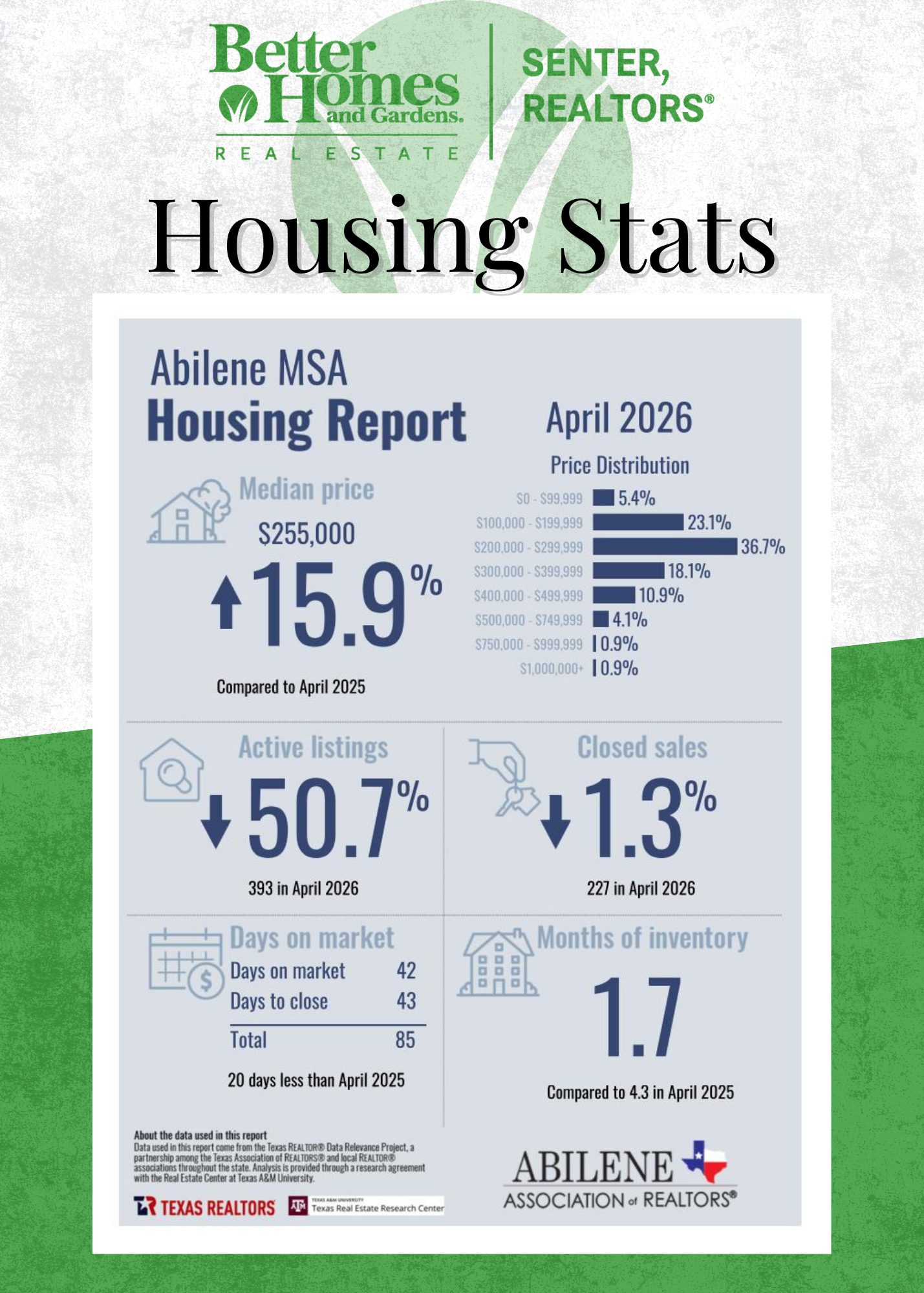
The Abilene MSA reported just 1.7 months of inventory in April 2026. In real estate terms, that is an incredibly tight market. Anything under about 4-5 months generally leans toward a seller’s market, and 1.7 months is firmly in “high competition” territory.
Median home prices climbed to $255,000, up 15.9% year-over-year, while days on market dropped significantly compared to last year.
At the national level, REALTORS® across the country are also reporting stronger competition:
- Average offers received increased from 2.2 in March to 2.5 in April
- 21% of properties sold above list price
- Median days on market fell from 41 days in March to 32 days in April
Why Is This Still Happening?
A major reason is that Texas continues to show strong economic and job growth.
Lawrence Yun, Chief Economist for the National Association of REALTORS®, recently pointed out that Texas remains one of the stronger employment regions in the country despite broader national uncertainty. Wage growth continues to outpace inflation nationally, helping improve affordability for many buyers.
Locally, Abilene continues to benefit from stable employment sectors, ongoing development interest, and population movement into the area. Demand has not disappeared here.
And importantly, the pre-existing home market still offers affordability compared to many other parts of Texas and the country.
That affordability is helping keep buyer demand elevated even as interest rates remain higher than many consumers would prefer.
But Higher Price Ranges Are a Different Conversation
Once you move beyond roughly the mid-$300,000s, the market becomes far more balanced.
Buyers have more options.
Negotiating power improves.
The urgency drops considerably.
Homes generally take longer to sell.
That does not mean those homes are not selling. They absolutely are. But it is no longer the same “list it Thursday and review offers Sunday” environment that many homes in the lower and mid-price tiers are experiencing.
This distinction matters tremendously for both buyers and sellers.
A seller in the $250,000 range should not be using the same expectations or strategy as a seller at $700,000. Likewise, buyers moving between price ranges often experience two entirely different markets.
New Construction Is Still Active — But Operating Differently
One important nuance in the latest data is that new construction is not necessarily weak. In fact, total closed sales in new construction are up nearly 50%.
What we are seeing instead is a market adjusting to demand realities and construction logistics.
The new construction numbers continue to show:
- Longer closing timelines
- Increased total transaction times
- Higher overall days to close
But much of that is tied to the reality that builders can only construct homes so quickly while demand remains elevated.
Unlike resale homes, many new construction transactions involve build timelines, material coordination, labor scheduling, inspections, and completion delays that naturally extend the process. That is very different from an existing home that is already complete and move-in ready.
We are also seeing many builders adapt directly to where the strongest buyer demand exists in Abilene.
Over the past couple of years, builders have increasingly shifted toward:
- Smaller floorplans
- More efficient layouts
- Lower overall price points
…in order to better serve the highest-demand segments of the market.
That adjustment reflects what the local data continues to show clearly: the strongest demand in Abilene remains concentrated in more affordable housing ranges where buyers are still actively competing for inventory.
Meanwhile, existing homes are often moving faster simply because they are immediately available and, in many cases, offer more value per dollar once buyers compare pricing, upgrades, landscaping, and financing costs.
What This Means Going Forward
Abilene is not following the national housing narrative evenly across all price points.
The local market remains heavily demand-driven where affordability still exists.
If a home is:
- Well priced
- In good condition
- In a desirable area
- And falls into that high-demand price range
…it is very likely still entering an extremely competitive environment.
At the same time, higher-end properties are operating in a more traditional and negotiable market.
That is why broad national headlines can sometimes create confusion locally. Real estate has always been hyper-local, and right now Abilene may be one of the clearest examples of that.
The market is not “slow.”
The market is not “hot.”
It depends entirely on where you are shopping.
And right now, those differences matter more than ever.